
Table of Contents
Evolution of Wireless Connectivity in Southern Idaho
Building on longstanding rural internet challenges in Southern Idaho, connectivity began with early 20th-century limitations like dial-up and satellite services in towns such as McCammon. The mccammon wireless company landscape revealed stark connectivity deserts, as National Telecommunications Cooperative Association (NTCA) benchmarks highlight persistent gaps in these remote areas. NTCA member maps and industry reports consistently document these coverage deserts, guiding local deployment priorities and helping providers target towers and fixed wireless links to communities most in need across Southern Idaho and neighboring rural counties today.
The mid-2000s marked a pivotal shift to mobile broadband, with 3G and 4G towers tackling rugged terrain challenges around Pocatello and Blackfoot. These advancements delivered faster speeds to underserved communities, laying groundwork for broader access across rural Southern Idaho.
Entering the 2020s, the 5G fixed wireless boom transformed rural internet idaho, enabling high-speed 5g fixed wireless internet without costly fiber trenching. As a premier rural Idaho internet provider, we at White Cloud Networks leverage state-of-the-art 5G wireless to bridge the digital gap for residents and businesses in Twin Falls and beyond, per NTCA maps showing dramatic coverage gains.
Looking ahead, hybrid wireless-fiber networks promise even greater dependability, ensuring fast, reliable internet for Southern Idaho’s future growth.
Fundamentals of Early Wireless Networks
Building on the evolution of connectivity, early wireless networks laid the groundwork for today’s high-speed services. In the 1980s and 1990s, providers like the mccammon wireless company pioneered analog cellular systems, focusing on reliable voice services in growing urban areas. These foundational technologies introduced critical advancements that shaped mobile communications, emphasizing call management and network reliability.
McCaw Cellular exemplified this era with analog cellular systems that revolutionized personal connectivity. A key innovation was the introduction of SS7 signaling, which enabled efficient call routing, handoffs between cell towers, and basic network management. Early networks prioritized urban expansion, deploying towers in cities to support increasing demand for mobile telephony. However, coverage remained limited in rural regions, highlighting the challenges of extending signals over vast distances. We at White Cloud Networks recognize these milestones as the starting point for our own innovations in southern Idaho.
The following table compares key aspects of early cellular milestones with modern fixed wireless:
| Era | Technology | Key Innovation | Coverage Focus |
|---|---|---|---|
| McCaw Cellular (1980s-1990s) | Analog cellular systems | SS7 signaling introduction | Urban expansion |
| White Cloud 5G (Today) | Fixed 5G wireless | High-speed low-latency | Rural southern Idaho |
This comparison highlights the progression from voice-centric analog systems to our state-of-the-art 5G wireless technology. Early efforts built scalable infrastructure, while today’s 5G fixed wireless internet delivers broadband capabilities previously unimaginable. According to NTCA – The Rural Broadband Association, authoritative industry data on rural telecommunications coverage in Idaho underscores the shift toward addressing underserved areas, as mapped in their Idaho state resources.
These advancements bridge the digital gap, enabling dependable internet in remote communities. For instance, solutions like Blackfoot ID Wifi Internet exemplify in-home Wi-Fi tailored for southern Idaho households. Our High-Speed 5G Wireless Internet and In-Home Wi-Fi Solutions extend 5g fixed wireless internet to places once overlooked.
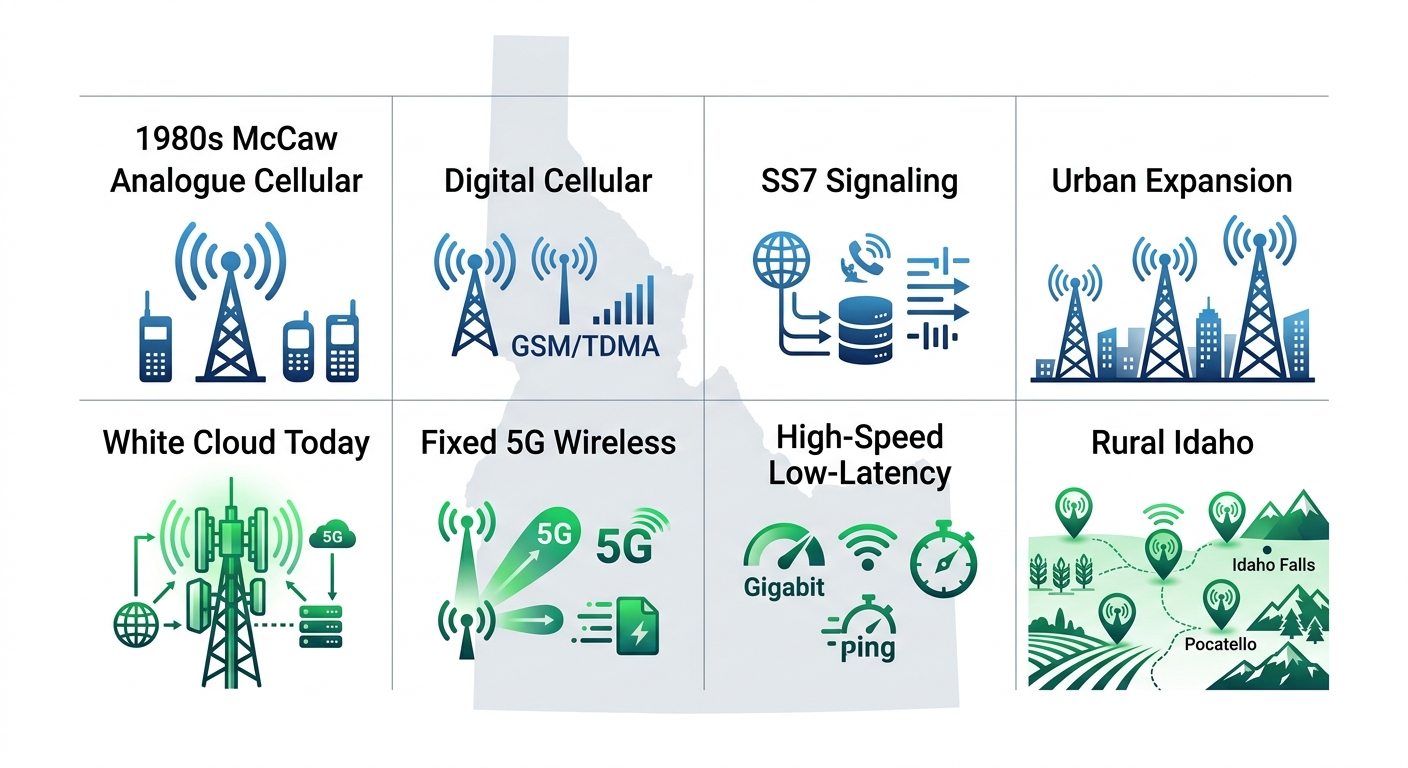
Comparison of early cellular vs modern fixed wireless milestones
White Cloud Networks, a premier Internet service provider serving southern Idaho and northern Nevada, leverages this heritage. Rural internet in Idaho now benefits from low-latency 5g fixed wireless internet, supported by our 24/7 Customer Support. This progression enables our state-of-the-art 5G solutions today.
McCaw Cellular Acquisitions and Expansions
Building on its foundational innovations, McCaw Cellular pursued aggressive expansions through strategic acquisitions in the 1980s and 1990s. This mccammon wireless company approach consolidated cellular licenses and cutting-edge technologies, transforming regional operations into a national powerhouse. We recognize how these moves laid the groundwork for modern wireless networks that bridge the digital gap in underserved areas.
Key Purchases and Growth Strategies
McCaw Cellular’s growth hinged on targeted purchases that expanded its footprint and capabilities. A prime example was the acquisition of LIN Broadcasting in the 1980s, which delivered valuable cellular licenses and fueled market expansion across key regions. This move allowed McCaw to scale operations rapidly in emerging wireless markets.
Next, the purchase of MCI operations in the 1990s introduced advanced signaling technologies, positioning McCaw for greater efficiency and integration. These assets not only enhanced network performance but also paved the path toward the landmark AT&T merger, consolidating industry leadership.
To complete its national strategy, McCaw targeted additional regional cellular assets, inferred from historical records as critical for building a comprehensive footprint. Key strategic buys included:
- LIN Broadcasting (1980s): Secured cellular licenses for immediate market expansion.
- MCI operations (1990s): Gained advanced signaling to streamline communications.
- Regional cellular assets (late 1980s): Bolstered coverage in underserved pockets, enabling nationwide ambitions.
These acquisitions exemplified McCaw’s focus on spectrum dominance and technological synergy, driving sustainable growth.
The following table compares McCaw’s strategic buys, drawing from historical records and industry timelines:
| Acquisition | Year | Technology Gained | Outcome |
|---|---|---|---|
| LIN Broadcasting | 1980s | Cellular licenses | Market expansion |
| Other MCI operations | 1990s | Advanced signaling | AT&T merger path |
This comparison highlights McCaw’s proactive edge over competitors, prioritizing licenses and tech that accelerated dominance.
Impact on National Wireless Infrastructure
McCaw’s acquisitions standardized cellular networks, hastening spectrum allocation and fostering nationwide coverage models. By integrating diverse licenses and signaling systems, McCaw created scalable infrastructures that influenced regulatory frameworks and operator consolidations. These developments accelerated the transition from analog to digital cellular, setting precedents for efficient spectrum use.
Today, we see parallels in rural internet in Idaho, where 5G fixed wireless internet deploys similar strategies to reach remote communities. The National Telecommunications and Information Administration (NTIA) recently approved Idaho’s initial proposals for the Broadband Equity, Access, and Deployment (BEAD) program, as per this authoritative government announcement on recent broadband infrastructure initiatives. With over $583 million allocated to Idaho, these efforts echo McCaw’s expansions by funding high-speed networks that bridge the digital gap. For instance, communities like Downey benefit from Downey ID Home Internet, exemplifying state-of-the-art 5G wireless for fast, dependable internet backed by our 24/7 Customer Support.
As a premier Internet service provider serving southern Idaho and northern Nevada, we leverage these historical lessons in our High-Speed 5G Wireless Internet and Fiber Optic Internet offerings. McCaw’s consolidation enabled the 5G fixed wireless internet backbone essential for rural connectivity, much like our tailored solutions for rural internet in Idaho. This evolution supports streaming, remote work, and telehealth, ensuring equitable access. These strategies echo in today’s solutions, previewing further advancements in wireless broadband.
5G Fixed Wireless for Rural Idaho
We at White Cloud Networks, a premier Internet service provider serving southern Idaho and northern Nevada, deliver state-of-the-art 5G fixed wireless as a fast, dependable internet solution for rural Idaho. As the leading mccammon wireless company, we address connectivity challenges in areas like McCammon, Idaho, ensuring residents enjoy reliable broadband.
Performance in Rural and Suburban Areas
In rural and suburban southern Idaho locations such as McCammon, Idaho, our 5G fixed wireless internet delivers impressive performance tailored for everyday needs. Download speeds reach up to 1 Gbps, enabling seamless streaming, remote work, and online gaming without interruptions. Latency remains low at 20-50ms, providing responsive connections ideal for video calls and real-time applications.
Reliability stands out in these settings, where traditional wired options often fall short. Industry standards and White Cloud specs confirm consistent uptime, even in varied terrain. Our network uses advanced towers to maintain signal strength, outperforming older wireless technologies.
Key benefits include:
- High download speeds: Up to 1 Gbps for multiple devices.
- Low latency: 20-50ms for smooth performance.
- Quick deployment: No extensive digging required.
For rural internet Idaho residents, this means accessing education, healthcare, and entertainment reliably. In McCammon, Idaho, and similar communities, our solution transforms internet options for rural Idaho, bridging distance-related hurdles effectively. Customers report fewer outages compared to satellite alternatives, thanks to our local infrastructure.
We compare our 5G fixed wireless performance against fiber optics as follows:
| Metric | 5G Fixed Wireless | Fiber Optic | Best For |
|---|---|---|---|
| Download Speeds | Up to 1 Gbps | Up to 10 Gbps | High-demand urban |
| Latency | Low (20-50ms) | Ultra-low (<10ms) | Rural quick deploy |
This comparison highlights 5G fixed wireless advantages for rapid rural rollout, where fiber deployment proves challenging due to geography.
Bridging the Digital Gap Today
Beyond performance, our hybrid approach at White Cloud Networks combines state-of-the-art 5G wireless and fiber optic technology to bridge the digital gap in southern Idaho communities. We deliver High-Speed 5G Wireless Internet alongside Fiber Optic Internet, creating resilient networks that adapt to local demands. In areas like McCammon, Idaho, this means fast, dependable internet without waiting years for fiber alone.
The National Telecommunications and Information Administration (NTIA) provides authoritative federal endorsement of state-level rural internet expansion initiatives, approving Idaho’s initial proposals under the Internet for All program. This includes funding for broadband deployment in underserved rural areas, aligning with our efforts to enhance connectivity across southern Idaho.
Our In-Home Wi-Fi Solutions ensure whole-home coverage, optimized for streaming and smart devices. As a wireless provider in McCammon and nearby regions, we extend similar benefits, much like our Chubbuck internet services, tailoring hybrid setups for suburban and rural homes alike.
24/7 Customer Support sets us apart, with local technicians monitoring networks continuously for swift resolutions. Whether troubleshooting or upgrading, our team supports rural internet Idaho needs promptly. Businesses benefit from scalable Business Internet Packages, incorporating Microwave Links and Point-to-Point Links for low-latency operations.
This hybrid model accelerates deployment, serving households and enterprises effectively. We bridge the digital gap by prioritizing underserved spots, fostering economic growth through reliable access to jobs, telehealth, and education. Our comprehensive offerings, including Tech Support / Customer Portal, empower users with self-service tools.
Contact us for your rural internet Idaho needs and discover tailored packages for business or residential use.
Advanced Hybrid Network Solutions
Building on our core offerings, our advanced hybrid network solutions elevate connectivity for southern Idaho communities. As a premier Internet service provider serving southern Idaho and northern Nevada, we deliver state-of-the-art 5G wireless and fiber optic technology that bridges the digital gap in rural areas. Our proprietary hybrid approach, positioning White Cloud Networks as the leading mccammon wireless company, combines 5g fixed wireless internet for broad coverage with fiber for unmatched speeds, ensuring fast, dependable internet even in challenging terrains.
This hybrid model excels by leveraging 5G fixed wireless internet to extend reach where traditional infrastructure falls short, then boosting performance with fiber backhaul in key locales like McCammon and Chubbuck high speed internet services. According to NTCA authoritative industry association insights on Idaho’s telecommunications landscape, rural internet idaho faces persistent coverage gaps that cooperatives address through innovative delivery. Our solution overcomes these by providing scalable bandwidth that grows with demand, alongside in-home Wi-Fi solutions and a dedicated tech support portal for seamless management.
The following table compares our hybrid offerings against traditional cellular networks, highlighting key advantages drawn from White Cloud USPs:
| Feature | Traditional Cellular | White Cloud Hybrid |
|---|---|---|
| Scalability | Limited | High for business |
| Support | Basic | 24/7 local |
White Cloud’s hybrid stands out in scalability, enabling businesses to expand without infrastructure bottlenecks common in traditional cellular setups. Our 24/7 Customer Support delivers localized expertise, with technicians from Twin Falls ready to assist, far surpassing basic provider responses. These differentiators ensure reliable performance for streaming, remote work, and operations in underserved spots.
Such capabilities make our networks ideal for dynamic needs. For instance, integrating microwave links enhances redundancy, while mesh networks optimize coverage in sprawling rural setups. NTCA data underscores the demand for these advancements in Idaho, where rural providers like ours drive progress.
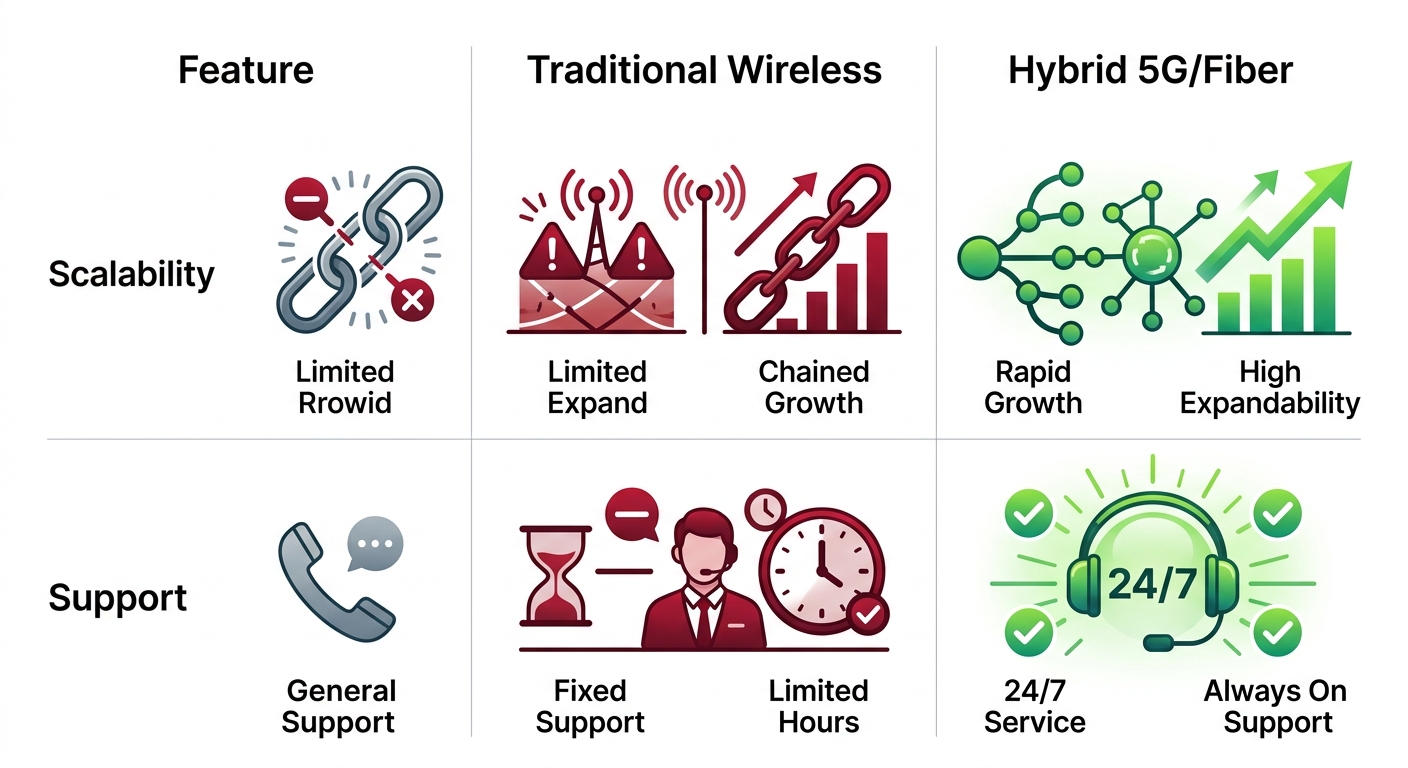
Hybrid 5G/Fiber vs traditional wireless: scalability and support comparison
These advantages position the mccammon wireless company at the forefront, making our hybrid solutions perfect for tailored business internet packages ahead.
Key Questions on Wireless Evolution
Building on foundational wireless tech, as a mccammon wireless company, we address evolution key to rural internet Idaho.
How has wireless technology evolved from 4G to 5G fixed wireless internet? From 4G limitations, 5G fixed wireless internet delivers faster speeds and reliability, ideal for southern Idaho homes via advanced microwave links.
What challenges does rural internet Idaho face, and how does wireless evolution address them? Sparse coverage persists; mesh networks and 5G fixed wireless service expand access, bridging the digital gap with our hybrid solutions.
Why choose a local mccammon wireless company for 5G fixed wireless internet? We provide 24/7 Customer Support and tailored Business Internet Packages, ensuring dependable internet for northern Nevada businesses.
How does White Cloud Networks contribute in Jerome? As a trusted Jerome Idaho internet provider, we deliver In-Home Wi-Fi Solutions and cell tower installation. A premier Internet service provider serving southern Idaho and northern Nevada, we lead with state-of-the-art 5G wireless.
These advancements enable our high-speed 5G wireless internet and fiber optic solutions.
Future Connectivity with White Cloud Networks
Building on our current high-speed 5G wireless and fiber optic internet, we at White Cloud Networks, the McCammon wireless company, are pioneering future connectivity through hybrid 5G fixed wireless internet and fiber optic networks. Our state-of-the-art 5G wireless and fiber optic technology will bridge the digital gap in southern Idaho and northern Nevada.
This vision extends to delivering fast, dependable internet to underserved rural areas in Idaho. We plan rapid deployment via 5G fixed wireless service alongside fiber for ultimate bandwidth, enhancing rural internet in Idaho. Tailored in-home Wi-Fi solutions and business packages will evolve with advancements like mesh networks and private transport.
As the McCammon wireless company expands coverage, we reaffirm our commitment to 24/7 Customer Support for reliable connectivity ahead.
This article was researched and written with the assistance of AI tools.